

What Common Law Marriage Means in Real Life: Rights, Requirements, and Legal Implications
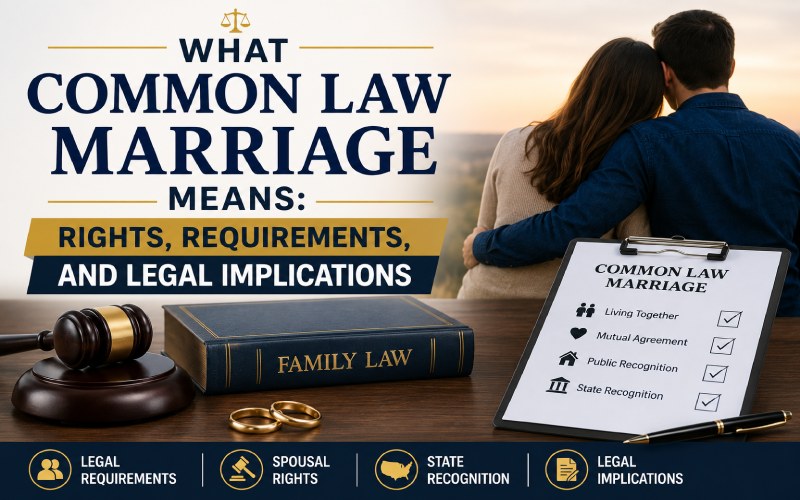
Common law marriage refers to a legally recognized marriage that may exist even though the couple did not obtain a marriage license or organize a formal wedding ceremony. Many people believe that merely living together for a long period will automatically create a common law marriage. However, in reality, it is one of the most common misconceptions among people regarding common law marriage. There are several conditions that must be met before a couple is considered legally married without a formal ceremony or marriage license.
What Is a Common Law Marriage?
In simple words, a common law marriage is a legally recognized marriage that is considered an official marriage, even though the couple did not obtain a marriage license or organize a formal wedding ceremony. It carries the same legal rights and responsibilities as a traditional marriage.
Is Common Law Marriage Recognized Everywhere?
No, only a few states recognize new common law marriages, whereas others simply:
- Do not recognize them at all.
- Recognize only those established before a certain date.
- Recognize valid common law marriages created in another state under certain circumstances.
The applicability of the common law marriage rule varies significantly based on states’ laws; it is important to refer to them to know its validity.
Common Requirements
Usually, common law marriage’s requirements include:
- Had the legal capacity to marry.
- Intended to be married.
- Lived together as spouses.
- Held themselves out publicly as a married couple.
Courts evaluate the overall scenario precisely and do not declare a decision on a single factor.
How Do Courts Determine Whether a Common Law Marriage Exists?
Courts examine multiple types of evidence to determine whether a common law marriage exists or not, such as:
- Joint tax filings
- Shared bank accounts
- Joint property ownership
- Insurance policies
- Statements made to family and friends
- Use of the same last name
- Documents referring to each other as spouses
What Rights Do Common Law Spouses Have?
After the establishment of a valid common law marriage, spouses usually receive rights related to:
- Property division
- Inheritance
- Spousal support
- Retirement benefits
- Health insurance
- Wrongful death claims
- Medical decision-making
These rights are like traditional marriage rights.
Can a Common Law Marriage End Automatically?
No, after the establishment of a valid common law marriage, it will end through a legal divorce. A valid common law marriage is considered a legal marriage and will end the same way.
What Happens If One Partner Dies?
If one partner dies in a valid common law marriage, then the surviving spouse will receive legal rights on:
- Inheritance
- Probate proceedings
- Retirement benefits
- Survivor benefits
- Other property rights
However, the availability of these rights significantly depends on the applicable laws and the relevant facts.
When Should You Consult an Attorney?
Legal advice in the case of common law marriage is crucial when:
- You believe a common-law marriage exists.
- You are separating from a long-term partner.
- Property ownership is disputed.
- Estate planning is involved.
- You have questions about inheritance or spousal rights.
An expert legal professional will explain how state law applies to your particular circumstances and help you make an informed decision.
Common Mistakes to Avoid
Here are some common mistakes that you should definitely avoid to protect your legal rights:
- Assuming cohabitation automatically creates a marriage.
- Ignoring state-specific legal requirements.
- Failing to document important financial arrangements.
- Assuming separation alone ends a common law marriage.
- Delaying legal advice when disputes arise.
Frequently Asked Questions (FAQs)
Does Living Together Automatically Create a Common Law Marriage?
No, living together or coming into a live-in-relationship doesn’t automatically create a common law marriage. Its requirements vary from state to state; you should check your local laws for more information.
Is a Common Law Marriage Legally Valid?
Absolutely, a recognized and properly established common law marriage is treated the same as a traditional marriage.
Do You Need a Divorce After a Common Law Marriage?
Yes, after the establishment of a valid common law marriage, you will need a divorce to end it.
Conclusion
A valid common law marriage carries the same rights and responsibilities as a traditional marriage and will end through divorce. It is one of the most misunderstood legal topics; many people think that merely living together for a certain period of time will convert their relationship into a common law marriage, but it is not true. Its rules vary significantly from state to state. In this article, we discussed this topic in detail and shared relevant information with you. If you need more help, you can connect with an attorney using Legably.